Rapid Friday Sale is Live!
Get exclusive discounts on all products
Dec 04, 2025

4 min read

Look, before you write a single line of code or spend a dollar on design, you need to systematically rip apart every assumption you have about your idea. I’m talking about your problem, your solution, and your market. This whole process is about moving from cheap, fast experiments—like just talking to people—to more concrete tests like landing pages. The goal is simple: get real-world evidence, not just opinions, that people have a problem and will actually pay you to solve it.
Let’s get real for a second: the odds are not in your favor. The startup graveyard is absolutely packed with brilliant products that nobody wanted.
The single biggest killer isn’t a lack of funding or a weak team. It's building a solution for a problem that doesn’t exist, or at least one that isn't painful enough for anyone to care about. This is the classic founder trap—falling in love with a solution before truly understanding the problem.
Idea validation flips that entire script. It’s not some tedious chore; it’s an insurance policy against wasting months, or even years, of your life and money. Think of it as your strategic playbook for making smart, evidence-based decisions instead of just guessing.
You have to approach validation like a scientist. You start with a hypothesis ("I believe busy professionals are secretly struggling with meal planning") and then you design experiments to prove or, more importantly, disprove it.
Your job is to actively seek out rejection and tough feedback as fast and as cheaply as you can. Sure, positive feedback feels good, but it's the negative stuff—the "I don't get it" or "I wouldn't use this"—that gives you the gold. That’s what helps you pivot, refine, or even kill an idea before you’re in too deep.
Your main goal in validation isn't to be right, but to get it right. You're hunting for the truth about what the market needs, even if that truth completely shatters your original concept.
This journey is a logical one, moving from broad hunches to specific proof. To get there, you'll need to answer a few critical questions in order:
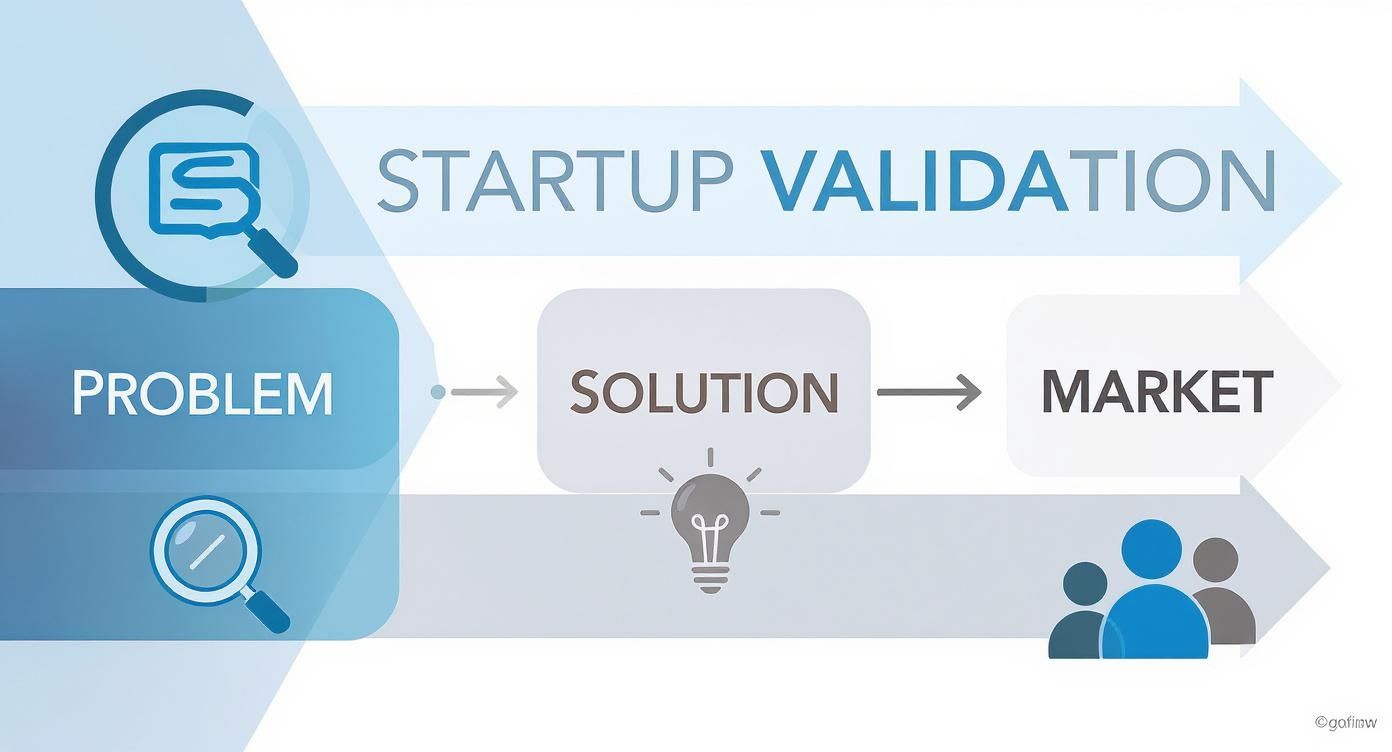
This all boils down to a simple but powerful sequence: nail the problem, then the solution, then the market. Never the other way around.
The data backs this up mercilessly. Roughly 90% of startups fail, and for first-time founders, that success rate plummets to a sobering 18%. These aren't just statistics; they're stories of founders who probably got excited and skipped these crucial early steps. You can dig into more of the grim details from startup failure rates from recent reports, but the key takeaway is clear: validate or die.
To help you stay on track, we've broken down the entire process into four core pillars. Think of this as your roadmap from a raw idea to a validated business concept.
| Pillar | Objective | Key Activity |
|---|---|---|
| 1. Problem Discovery | Confirm a painful, urgent problem exists for a specific group of people. | Conducting customer interviews and market research. |
| 2. Solution Design | Develop a value proposition that resonates with your target audience. | Crafting user personas, value propositions, and early mockups. |
| 3. Low-Fidelity Testing | Get early signals of interest without building a functional product. | Running landing page tests, smoke tests, and surveys. |
| 4. High-Fidelity Testing | Test real user behavior with a minimal, functional version of your solution. | Building a Concierge, Wizard of Oz, or Minimum Viable Product (MVP). |
Each pillar builds on the last, systematically de-risking your idea and moving you closer to something the market actually wants. Let's dive into the first one: Problem Discovery.
It’s way too easy to fall in love with your app idea. You can already see the slick interface, the killer features, the five-star reviews rolling in. But hold on. Before you write a single line of code, you have to fall in love with something else entirely: the problem.
Your brilliant idea is nothing more than a guess until you can prove that real people are struggling with the exact pain point you want to solve. The fastest and cheapest way to do that? Get out of your office and talk to them.
Customer interviews aren't sales pitches. Think of them as discovery missions. Your only job is to become an expert on your target customer’s world—their frustrations, their daily grind, and the messy workarounds they've cobbled together just to get by. This is where the gold is buried.
First things first, you need to figure out who to interview. A word of caution: don't just ask your friends and family. They love you, which means they'll likely tell you what you want to hear. You need unbiased feedback from people who genuinely fit your Ideal Customer Profile (ICP).
Start by sketching out a simple persona. Who is this person, really?
Once you have a decent picture, go to those online communities. Don’t just drop a link to your half-baked idea. Instead, ask for their expertise. A simple post like, "Hey designers, I'm researching how freelancers manage client feedback. Would anyone be open to a 15-minute chat about their process?" works like a charm.
The success of your interviews boils down to the questions you ask. The golden rule here is to avoid leading questions at all costs. You're not looking for a "yes" or "no." You're hunting for stories. Your job is to listen, not to steer the conversation toward your solution.
A bad question just confirms what you already think you know. A great question challenges your entire premise. Instead of asking, "Wouldn't it be great if you had an app that organized your recipes?" you'll get so much more by asking something open-ended.
A great customer interview feels more like a therapy session for the customer than a pitch from you. You’re there to listen to their problems, not to sell them on your solution.
Here’s a simple way to reframe your questions to pull out genuine pain points:
| Instead of This (Leading Question) | Try This (Open-Ended Question) | Why It Works |
|---|---|---|
| "Don't you hate managing invoices?" | "Can you walk me through your process the last time you sent an invoice?" | This forces them to recall a specific, real experience, revealing the tools, frustrations, and time they actually spent. |
| "Would you pay for a meal-planning app?" | "Tell me about how you decided what to eat for dinner last week." | This uncovers their current habits and budget, and tells you if meal planning is even a real priority for them. |
| "Is finding a reliable dog walker difficult?" | "What was the most frustrating part of finding care for your dog recently?" | This zeros in on a specific pain point and its emotional weight—a huge indicator of a problem worth solving. |
Your mission is to dig for emotion. When you hear words like "frustrating," "annoying," or "time-consuming," you're getting warm. Follow up with a simple, "Tell me more about that," and let them talk.
Okay, you've found a problem. But is it a "nice-to-have" or a "must-have"? The ultimate validation is confirming the problem is so painful that someone would actually pay money to make it go away. You need to gently probe for this without turning the interview into a hard sell.
After they've detailed their struggles and current workarounds, you can test their commitment with a few smart questions:
Pay close attention to how they describe the problem's impact. If they mention losing money, missing out on opportunities, or serious personal stress, you've likely hit a nerve—and found a problem with a budget attached to it. That's the signal you need before you move on to the next stage.
Okay, you've done the hard work of talking to real people. You’ve listened, you’ve learned, and you’re pretty sure you’ve pinpointed a genuine, painful problem. It's incredibly tempting to dive headfirst into building the app.
Pump the brakes.
Before a single line of code gets written, you need to test if your proposed solution actually clicks with anyone. This is the moment for low-fidelity experiments—quick, cheap ways to see if real market interest exists.
The goal here isn't to build anything functional. It's to simulate the promise of a product. You just want to see if people will take a small, meaningful action—like giving you their email address—based on your value proposition alone. That tiny commitment is a huge signal that you're onto something.
The quintessential low-fi experiment is the smoke test. Think of it like putting a "Coming Soon" sign in an empty storefront just to see how many people stop and try to peek inside. A smoke test landing page does the exact same thing for your app idea.
It’s just a simple, one-page website with a single mission: get visitors to sign up for a waitlist. This is your first real test of converting someone's problem-awareness into genuine interest in your solution.
And the best part? You don't need a developer.
A smoke test isn't about tricking people. It’s an honest handshake. You’re essentially saying, "I'm thinking of building this to solve your problem. If that sounds interesting, let me know, and I'll keep you in the loop."
Your landing page should feel like a direct response to your customer interviews. Use their exact words. If they kept complaining about "wasted hours tracking expenses," your headline had better be something like, "Stop Wasting Hours on Expense Reports."
The engine of your landing page is its value proposition. This isn’t a list of features; it's a concise promise that instantly answers three questions for any visitor:
For example, if you're building a meal-planning app for busy parents, a weak proposition is "The Best Meal Planning App." A much stronger one would be: "Effortless Meal Planning for Busy Families. Spend less time stressing and more time at the dinner table." It’s specific, targeted, and connects on an emotional level.

Once the page is live, you need to get some eyeballs on it. Don't worry about going viral; you're just looking for a small, highly targeted group of your ideal users to see how they react. A tiny budget of $50-$100 is often plenty to get the initial signal you need.
Here’s how to get that first wave of traffic:
If you’re building an app, this is also a great time to start thinking about the tech stack. Getting familiar with your options now can save you a ton of headaches later. For a good primer, check out this guide on cross-platform app development tools, which can give you a feel for how fast you might be able to spin up a future prototype.
The only metric that matters at this stage is your conversion rate—the percentage of visitors who sign up. For highly targeted traffic, a 5-10% conversion rate is a fantastic signal. If it's lower, your value proposition probably needs another look. This number is your first real piece of evidence that you're on to something people actually want.
Alright, so you've got a landing page and a growing list of emails. That's a great start. It proves people are interested in the promise you're making. But intent doesn't pay the bills.
To see if your idea has real-world legs, you need to bridge the gap between that promise and an actual, functional solution. This is where the Minimum Viable Product (MVP) comes in, and it's one of the most misunderstood concepts in the startup world.
An MVP isn't just a buggy, stripped-down version of your final app. Think of it as a strategic tool built to answer one question: does my core idea actually deliver value to a user? It's all about learning as fast as you can with the least amount of wasted effort. You're shifting from collecting emails to collecting behavioral data—the real truth.

Building an MVP doesn't always mean writing code. In fact, some of the most powerful insights come from clever, low-tech approaches that get you interacting with users immediately.
The Concierge MVP: You literally become the product. For your first few customers, you deliver the service entirely by hand. Building a personalized meal-planning app? You'd personally create meal plans for your first users over email and Zoom. This approach gives you an unparalleled, ground-level view of your customer's real problems and workflow.
The Wizard of Oz MVP: This one is a bit of smoke and mirrors. From the user's perspective, they're interacting with a slick, automated system. Behind the curtain, however, it's just you (and maybe a spreadsheet) pulling all the levers. Imagine a food delivery app where, in the beginning, an order just sends you an email, and you personally call the restaurant to place it. It lets you test the user experience long before you build any complex backend logic.
These non-code approaches are gold. They let you validate the core service before a single line of code is written, helping you figure out what's essential versus what's just a "nice-to-have."
For mobile app founders, an interactive prototype is often the most logical next step. But that doesn't mean you need to lock yourself away for six months. Speed is everything. Your only goal should be to build the single, core user journey you need to validate.
This is where pre-built components and templates are a game-changer. Why build every screen, button, and menu from scratch when you can use a production-ready starter kit to piece together a high-fidelity prototype in just a few days?
An MVP is about maximum learning for minimum effort. If you spend months building it in a silo, you've missed the entire point. You're just building a product, not a learning machine.
If you're in the React Native world, platforms like TheAppMarket give you a massive head start. You can grab a full app template—for anything from a fitness tracker to a taxi booking service—and just tweak it to test your unique value proposition. This gets a polished, native-feeling app into users' hands fast, so you can gather feedback on an experience that feels real.
And if your idea involves complex logistics, you can get a blueprint by studying how to build an app like Uber, which breaks down the essential features you'd need to prioritize for an MVP.
No matter which type of MVP you choose, its success is measured by one thing: the quality of the feedback loop it creates. You're building an engine for learning. Does it solve the user's main problem? Where do they get confused? What feature do they instinctively look for that isn't there?
The data on this is crystal clear. Startups that take the time to validate their ideas simply do better. One study found that 70% of startups that used market research and MVP testing saw higher success rates and got to market faster. Those who actively gather and act on customer feedback are the ones who find product-market fit.
This isn't about asking users what they want in a survey. It's about watching what they do. Are they completing the core task? Do they come back tomorrow? Are they telling their friends? This is the kind of behavioral data that truly matters, and it sets you up perfectly for the next step: measuring your progress.
You’ve run your experiments and have a pile of initial feedback. Great. Now comes the part where you separate the signal from the noise, and that means looking at the right data. If you don't have clear metrics, you're just flying blind, mistaking clicks for commitment.
It’s way too easy to get hooked on vanity metrics. These are the numbers that feel good but mean almost nothing—think page views, social media likes, or total app downloads. They give you a nice ego boost, sure, but they don't prove you've built something people actually need or are willing to pay for.
The real game is tracking actionable metrics. These are the data points that show real user engagement and tell you whether to pivot, persevere, or pull the plug. Each validation stage has its own set of numbers that count.
<iframe width="100%" style="aspect-ratio: 16 / 9;" src="https://www.youtube.com/embed/oC7PTSk7NFk" frameborder="0" allow="autoplay; encrypted-media" allowfullscreen></iframe>So, what does "good" even look like this early on? You need realistic benchmarks to make sense of your results without getting carried away or completely discouraged. For a simple landing page test, your main metric is the email sign-up conversion rate. This is your first real gut check on market interest.
While the numbers can swing depending on your industry, a solid benchmark keeps you grounded. According to data from KickoffLabs, campaigns hitting a conversion rate over 20% are generally on the right track. The average for startups on their platform is around 35%, and that can go even higher with smart referral programs.
If your conversion rate is stuck in the low single digits, that’s a loud, clear signal that your message isn't landing. Don't throw more money at ads; it's time to go back and rethink your value proposition.
Once you get an MVP into people's hands, the goalposts move. You're no longer just measuring interest; you're measuring actual behavior to see if your solution delivers on its promise.
Here’s what you should be tracking at the MVP stage:
To keep things straight, here's a quick cheat sheet for the metrics that matter most at each stage.
| Experiment Type | Primary Metric | Success Signal (Example Benchmark) |
|---|---|---|
| Landing Page | Email Sign-up Conversion Rate | 10-15% is decent; 20%+ is great. |
| Smoke Test (Pre-orders) | Pre-order Conversion Rate | Even 1-2% can be a strong signal of purchase intent. |
| Concierge/Wizard of Oz | Manual "Aha!" Moment Completion | 80%+ of trial users successfully complete the core task. |
| MVP/Prototype | Retention Rate (Week 1) | 15-20% week-over-week retention is a solid early signal. |
Think of this table as a starting point. Your numbers will vary, but having these benchmarks helps you make objective calls instead of just going with your gut.
Not every insight shows up on a dashboard. The "why" behind the numbers often comes from qualitative feedback, and honestly, it can be even more revealing.
Keep an ear out for these unprompted, high-value signals:
The strongest validation you can get is when someone uses your MVP and then tells a friend about it, completely unprompted. That's when you know you've created real value.
When you blend hard data with these human insights, you get the full picture. It’s this balanced view that gives you the confidence to make the right calls for your startup—to know when you're truly building something people don't just use, but will champion.

It’s completely normal to have a million questions when you're in the thick of it. Moving from a gut feeling to real-world experiments can feel uncertain. Let's tackle some of the most common questions that pop up for founders right where you are now.
This one comes up all the time. Forget about a magic number. Your real goal is to hit saturation—that point where you start hearing the same problems, using the same lingo, and seeing the same pain points crop up again and again. You’ll just know when the patterns start emerging.
For most B2B or even B2C ideas, you'll likely start seeing these clear patterns after 10-15 solid interviews with people who are a perfect fit for your ideal customer profile. If you’re 20 conversations in and still getting wildly different stories, that’s a red flag. It usually means your target audience is too broad and you need to niche down.
I get it. This fear paralyzes a lot of founders. But the hard truth is that an idea alone is practically worthless. It's all about the execution. The risk of you building something absolutely no one wants is infinitely higher than the risk of someone running off with your idea.
Think of it this way: keeping your idea locked up starves it of the feedback it desperately needs to grow. Being open gets you the insights to build something the market actually craves. By the time you’ve validated your assumptions, you’ll be so far ahead in customer understanding that any copycat would be playing a hopeless game of catch-up.
"The bigger risk isn't that someone will steal your idea. It's that you'll waste years of your life building something that nobody will use."
Negative feedback isn't failure. It's the entire point of validation. Every "no," "I don't really get it," or "I wouldn't use this" is a golden nugget of data that saves you time, money, and heartache down the road. It’s a gift, steering you away from a dead end.
When you get hit with criticism, your job is to get curious, not defensive. Dig deeper. Ask follow-up questions to understand the "why" behind their reaction.
Embrace the critiques. Seriously. They are the signposts that guide you toward a product people will be banging down your door to use. The goal here is to find the truth, even if it’s not the one you wanted to hear.
Validation should be ridiculously cheap. In the beginning, it should cost you nothing more than your time. Customer interviews? Free. Low-fidelity experiments like a quick landing page? Cheaper than a couple of pizzas.
Here’s a realistic look at an early-stage validation budget:
The guiding principle is simple: spend as little as possible to learn as much as possible. If an experiment feels like it requires a big financial investment, you're probably overcomplicating things for this early stage. You’re here to de-risk your idea, not bet the farm on it.
Ready to build your prototype without the months-long development cycle? At theappmarket, we provide production-ready React Native templates that give you the ultimate head start. Launch your validated app idea faster and start gathering real user feedback in days, not months. Explore our templates and UI kits at https://theappmarket.io.
Dec 08, 2025
4 min read
android login with facebook: Learn to set up the Facebook SDK, manage tokens, and implement secure authentication across native Android, cross-platform apps.
Dec 07, 2025
4 min read
Master the alert in React Native. Learn to handle platform differences, build custom modals, and apply best practices for a seamless user experience.
Dec 06, 2025
4 min read
keyboardavoidingview react native: Master keyboard handling with KeyboardAvoidingView across iOS, Android, Expo, and TypeScript.

Dec 05, 2025
4 min read
A practical guide to implementing a React Native PDF viewer. Learn to compare libraries, handle native setup, and troubleshoot common issues with real code.
Dec 03, 2025
4 min read
how to make app like uber: Learn core features, tech stack, development steps, testing, and launch tips.

Dec 02, 2025
4 min read
Build a rock-solid React Native setup. This guide covers Expo vs. Bare workflows, TypeScript, pnpm monorepos, NativeWind, and deployment strategies.
Dec 01, 2025
4 min read
A practical guide to Stripe React Native integration. Learn to set up your server, build payment UIs, handle webhooks, and launch secure mobile payments.
Nov 30, 2025
4 min read
Learn how to master push notifications in React Native. This guide covers setup, best practices, and advanced techniques for engaging your users.

Nov 29, 2025
4 min read
Build powerful location-based apps with our practical guide to react native with google maps. Get setup guides, pro tips, and best practices for iOS & Android.
Nov 28, 2025
4 min read
Explore deep linking react native with a practical guide to configuring URL schemes, universal links, navigation, and testing for Expo and bare apps.

Nov 28, 2025
4 min read
A practical guide to building a scalable React Native design system. Learn to implement tokens, theming, and tools like NativeWind and gluestack-ui.
Nov 26, 2025
4 min read
Learn why react native expo templates speed up your projects with ready-made patterns and practical tips.
Nov 25, 2025
4 min read
Discover how to improve developer productivity with actionable strategies for workflow, tooling, and culture. A practical guide for software engineering teams.
Nov 24, 2025
4 min read
Discover the best cross platform app development tools. Compare top frameworks like Flutter and React Native to build and ship apps faster.
Nov 23, 2025
4 min read
This Expo React Native tutorial provides a hands-on guide to building cross-platform apps. Learn setup, styling with NativeWind, navigation, and deployment.
Nov 22, 2025
4 min read
Build beautiful UIs faster with this guide to Tailwind CSS React Native. Learn setup, styling, and advanced techniques with NativeWind for mobile apps.
Nov 21, 2025
4 min read
Explore our curated list of 7 top-tier React Native app examples. Discover production-ready templates and resources to build your next app faster.
Mar 19, 2025
4 min read
theappmarket offers React Native UI templates to accelerate development. Get customizable, production-ready React Native app templates and Ui kit, some free. Build faster & smarter today!